

Coal: The Next Chokepoint
How 'peak coal' could become China's Achilles' heel

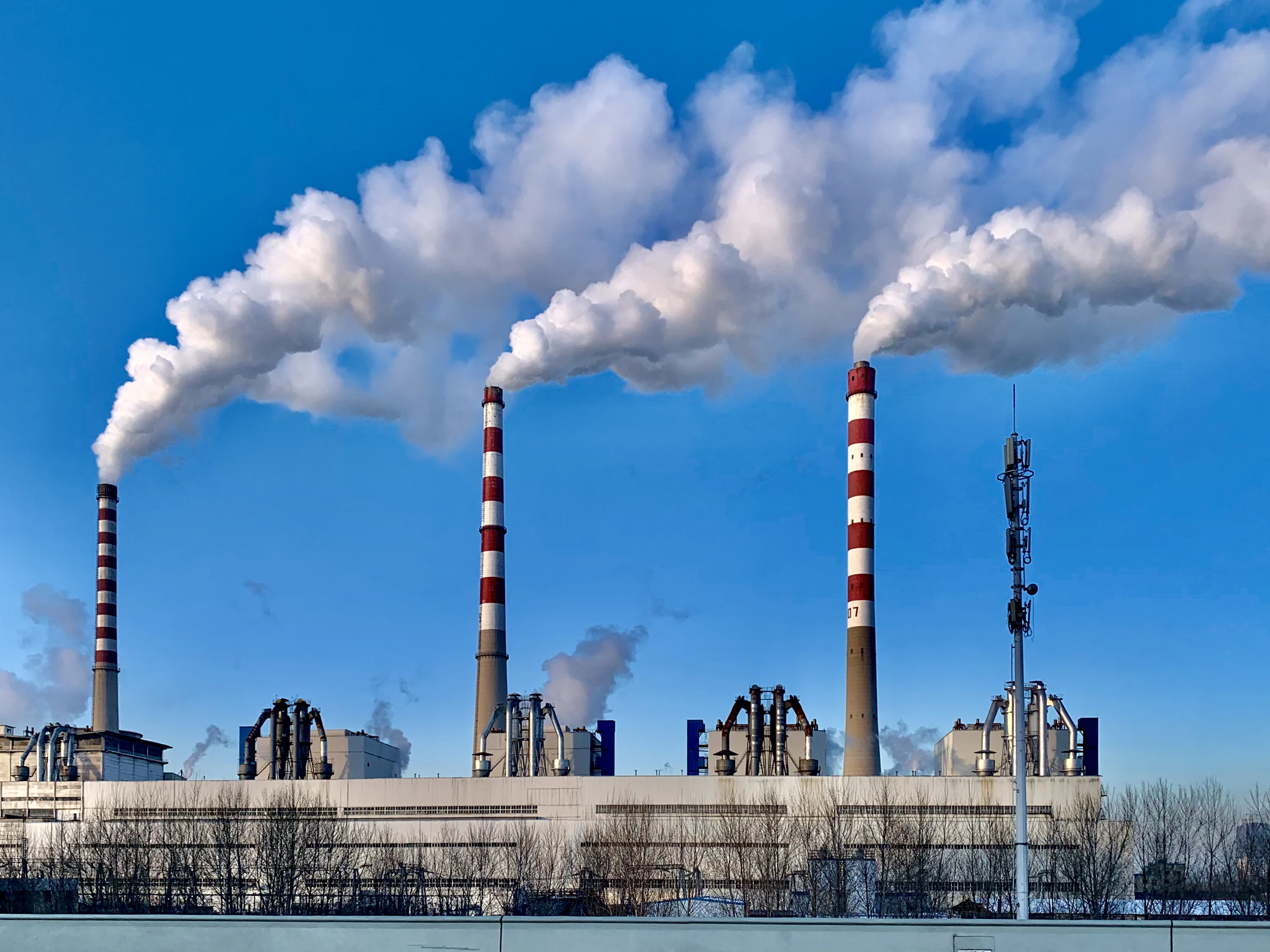
China has a growing coal supply problem marketed as “peak demand.” And while the public’s attention is drawn to the growth in “renewable” electricity generation and lower CO2 emissions from the building material industry, China’s increasing dependence on coal-to-chemical processes spells strategic vulnerability and forebodes a worsening economic and environmental predicament in the decades ahead.
As a reader funded publication your one time and regular donations help keep this newsletter going. If you value this article or any others please share it far and wide and consider a subscription. You can also support this work by buying a virtual coffee. Thank you!

The Coal Powered Civilization
Coal has made the Chinese economy what it is today. It provided all the cheap electricity and high heat needed to turn a poor agrarian economy of the mid 20th century into the high-tech, highly industrialized nation we know today. Without it’s massive domestic coal industry China could not have possibly made ‘the great leap forward’ let alone turning itself into the manufacturing hub of the world. Despite the massive deployment of “renewables” and a push to electrify, China’s economy has remained utterly dependent on coal. Just take a look at the chart below:
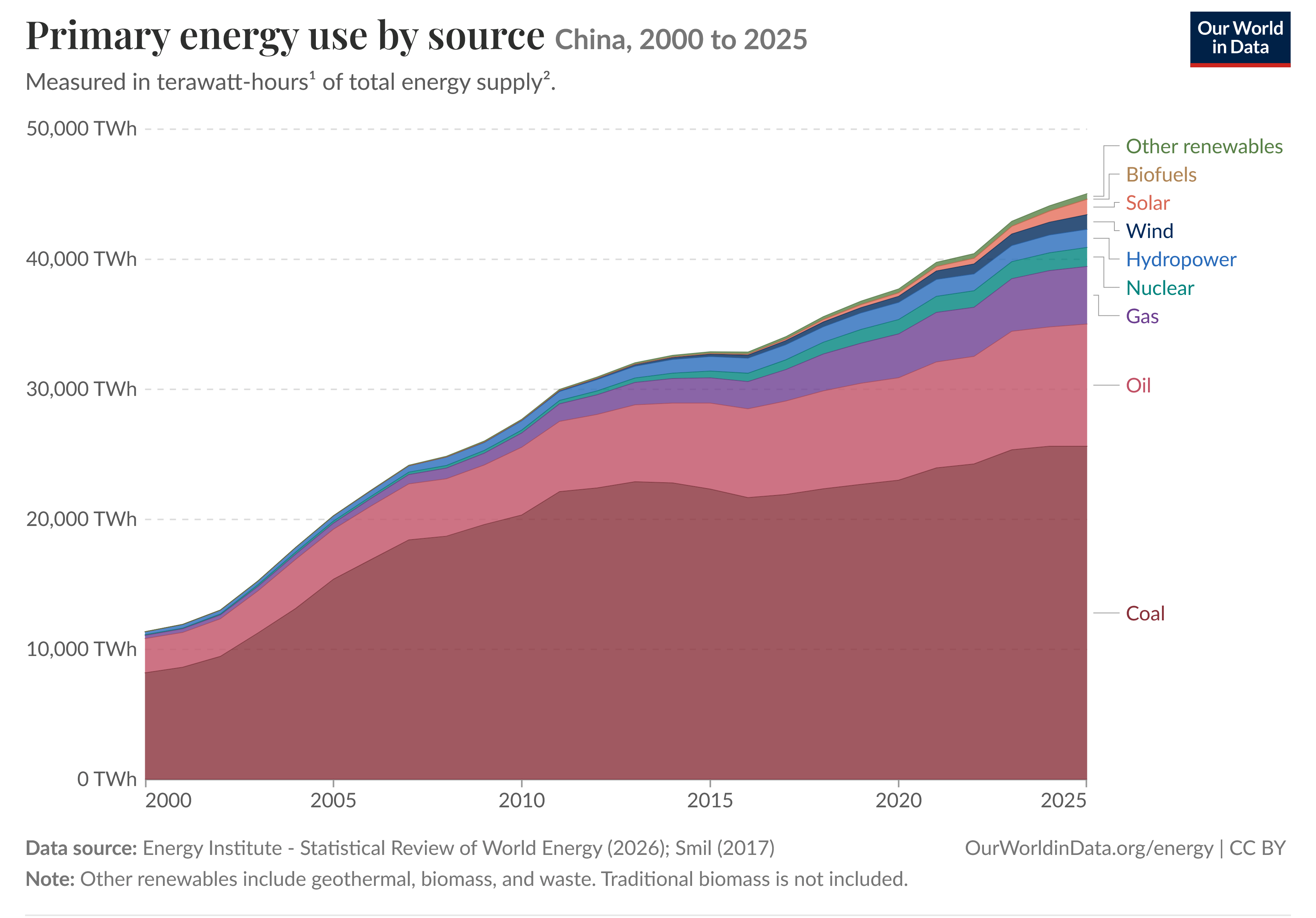
No wonder China is still the number one consumer of coal worldwide—by a long shot. In 2025 the East Asian country consumed 55% of all coal mined on planet Earth, 70% of which was turned into electricity.1 It’s no surprise that China tries to reduce its massive dependency on coal by deploying more and more solar panels and wind turbines... But did it help? To a certain extent yes it did, with “clean energy growth” now accounting for all energy additions to the grid there. On the other hand, feeding so much weather dependent, intermittent electricity to the grid has only reduced the utilization of new and existing coal fired power plants—but did not see their gates closed in droves.2 Phasing out coal power generation will not be nearly as easy as the headlines might suggest.
Coal consumption in China is not just about electricity, though. 30% of all coal burned there is consumed by the industry and heating applications (mostly in northern provinces). Metallurgy—especially steel making—requires a lot of high heat, as well as those dirty carbon atoms themselves. Coking coal used by smelters is a cheap, abundant and very effective reducing agent, removing the oxygen content of metal ores, while also providing the heat needed to extract pure iron. Or silicon, for that matter, required by solar manufacturers and wafer fabs alike. No wonder the country generated only 10% of its total steel output in 2025 from costlier electric arc furnaces, which is well below the goal of 15% set by the government and the global average of 30%. The irony is hard to escape here: the Chinese government wants the industry to use electricity largely generated by coal to reduce the coal consumption of making steel. And no, you can’t provide the stable electric current needed to that with “renewables” either, only hydro and thermal power plants cut it, with the former facing geographic as well as climatic limitations.
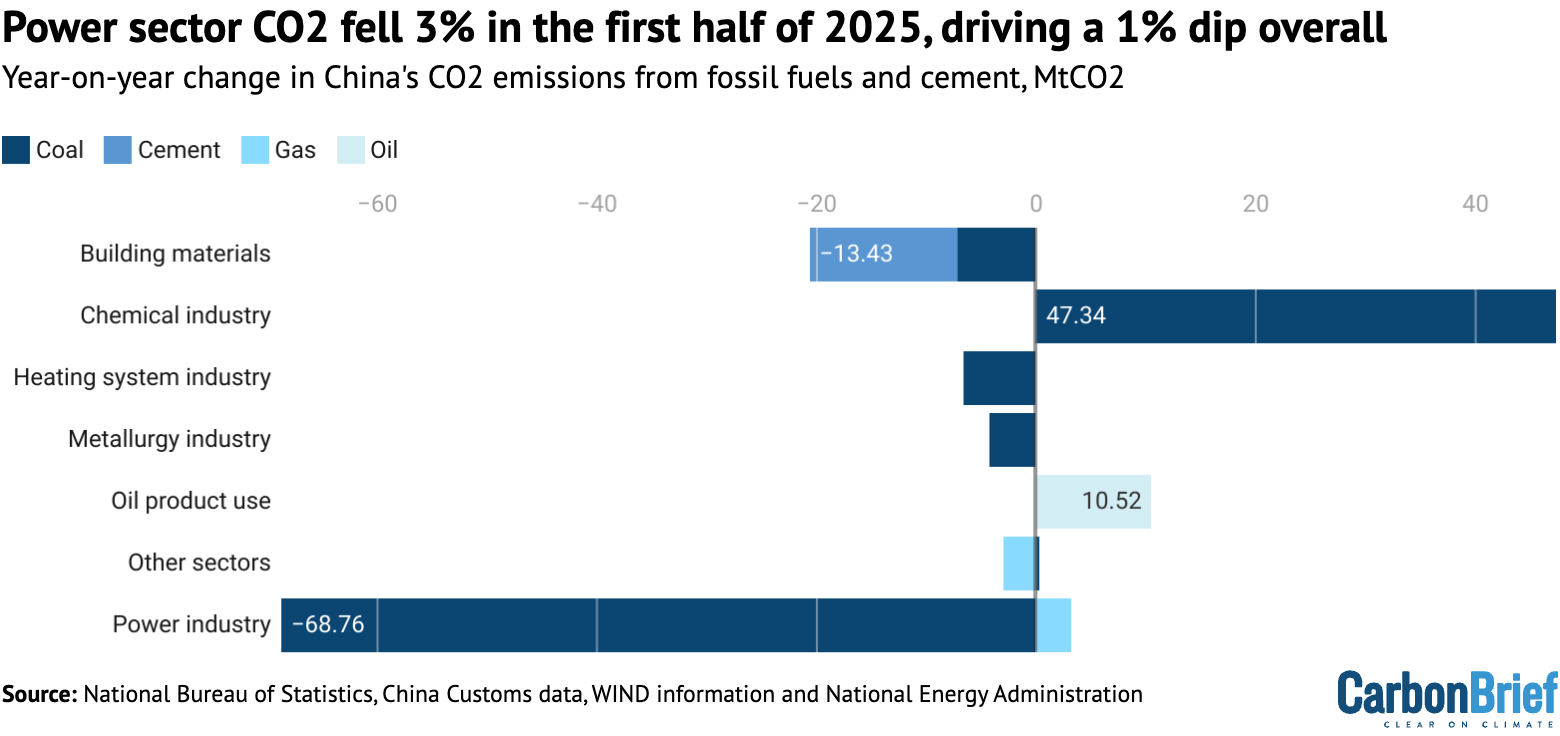
So, if you take a look at year-on-year changes in China’s CO2 emissions from fossil fuels and cement you can clearly see where the industry is headed. Emissions from building materials (mostly cement and steel) are down not because China have made a breakthrough in the making of these essential building blocks of modern civilization via electrified processes, but because demand from the construction sector has continued it’s almost decade long decline. Real estate investment fell 11% and the floor area of new construction starts slid by 20% in 2025 alone. Traditional targets of government infrastructure investment, such as transportation, also showed relatively slow growth. Power sector demand for coal was also reduced by 3% in 2025, but then bounced back up by a similar margin this year due to restricted LNG flows from the Persian Gulf.
China’s coal dependency, as demonstrated by a slowly but steadily rising demand from the industry and the power sector, is going nowhere. The recent stall in coal demand increase came from lower coal power plant utilization and a weak construction sector, not a revolution in electrification and “clean energy.” All those solar panels and wind turbines came on top in the form of an energy addition, not substitution.
The Dependency Deepens
The only real, tangible change in coal use has come in the shape of a rapid rise in coal-to-chemicals processing.3 China, recognizing its vulnerability to oil imports, has quietly built out a massive coal liquefaction and gasification industry to turn coal mined in remote regions like Xinjiang into valuable chemical inputs used by a range of industries. Doing so they hit two birds with one stone: having replaced 100 million tonnes of oil equivalent (or ~2 mb/d) of oil and gas annually, while making remote costly-to-transport coal worthwhile to extract at the same time. See, shipping valuable chemicals via rail is far more profitable than doing the same with lumps of coal. This new industry also provided 80% of the urea fertilizer produced by China, allowing the country to maintain its annual urea exports of ~5 million tons and saving natural gas (from which urea is traditionally made) for other uses.
Investing so heavily into the coal-to-chemicals industry, however, was nothing more than swapping one dependency with another.
These chemicals do not come for free, let alone without a massive environmental cost—another reason why remote, sparsely populated areas such as Xinjiang saw new chemical plants spun out of the ground like mushrooms. The sector consumed approximately 390 million tonnes of coal in 2024 already, resulting in an estimated 690 million tonnes of CO2 emissions, making it responsible for 6% of China’s fossil CO2 emissions and 9% of the country’s coal use in 2024. Coal liquefaction plants, such as Erdos in Inner Mongolia, use 7-12 metric tons of fresh water per metric ton of product, while generating 4.8 metric tons of wastewater and nine metric tons of carbon dioxide in the process. About half of the coal input by weight leaves the plant via the smokestacks, making coal-to-chemical processes one of the most wasteful industrial processes in history. Not to mention its very high water consumption and pollution, which makes the sustainability of such operations in the dry North-Western regions of China more than questionable. And while there are efforts to throw “renewable” electricity into the mix (generating green hydrogen to lower the energy demand of the coal gasification process) that doesn’t change the fact that China is drawing down non-renewable resources at a totally unsustainable rate in the process.

All this makes one wonder which one of the two critical inputs will run out first: freshwater or coal? While the former might seem obvious, given the semi-arid continental climate of Xinjiang and Inner Mongolia, the latter needs more explanation. In 2025 China produced 4663 million tonnes of coal, more than the rest of the world combined, and 24% more than during the 2011-2021 period when Chinese coal production seemed to have reached a high plateau. This latest output increase came in the heels of severe domestic power shortages and blackouts in 2021, stemming from a post-lockdown economic recovery, driving massive electricity demand and urging the government to intervene. The Chinese government, in response, prioritized energy security, ordering domestic mines to ramp up output to maximum capacity, reopening previously closed operations and fast-tracking new approvals to prevent future grid failures. To fulfill the output targets and delivery contracts, miners have prioritized quantity over quality, exploiting lower quality coal reserves to hit the quota, or reducing the coal washing they usually carry out to increase the quality of their product. In other words: this massive surge in coal output was a one time boom, not a new trajectory leading to ever higher and higher production.
The rapid expansion of coal extraction has also changed the structure of China’s coal mining industry, as coal production growth has come mainly from smaller producers. China's National Development and Reform Commission (NDRC) and National Energy Administration (NEA) in their "15th Five-Year Plan for Coal Industry Development," released just recently, have thus defined several key targets for 2030 to address these issues. Most notably: requiring the share of large, modernized coal mines to reach 87% of all domestic production, with intelligent mines (digitally connected and highly-automated worksites using AI and real-time data to optimize mining operations) reaching 75%. Additionally, an annual coal production capacity reserve of over 100 million metric tons is also to be established to strengthen the energy safety net. So far so good, but what’s the catch?
China’s coal reserves stood at 143.2 billion metric tonnes in 2020, equivalent to a mere 37 years of output, even at pandemic-low extraction levels. At today’s production rates, this reserve would run out in about 30 years. So while on the short term it’s certainly possible to grow output even further—especially by opening mines in previously “undeveloped” mining regions in the West of the country—China’s long time prospects remain bleak, to say the least. See, mineral production is not a flat line which abruptly drops off to zero when resources deplete, but follow a bell shaped curve with annual production rate peaking then slowly tapering off decades before the last mine closes its doors. No wonder coal “consumption” is expected by the government to peak before 2030—because if it doesn’t that means trouble. A big one. And with the coal to gas industry—already consuming 9% of all coal burned in China—set to triple by 2030, there is little reason to think that coal demand could peak before supply.
Over the past five years China has become more dependent on coal than ever during its 5000 years of history. China has grown into the world’s largest coal importer, scooping up ~30% of all export capacity worldwide in the past few years (compared to ~19% before 2021). China, at the end of 2025, already imported more than 11% of its overall coal consumption, thus with domestic production (not consumption!) peaking as reserves deplete and mines are retired, they will likely face a massive and worsening coal squeeze in the years and decades ahead. Especially, if their largest foreign supplier by far, Indonesia, continues to industrialize leaving less and less coal for export. Beijing will then have to rely increasingly on Mongolia and Russia for imports. Since moving coal thousands of miles via rail would take a lot of energy, this would be a costly and limited option compared to seaborne imports. I expect the United States to grab this opportunity trying to put a squeeze on and to gain leverage over the Chinese economy.
Conclusion
Electrification is not possible without metallurgy (steel, aluminum, copper etc.), requiring massive inputs of cheap, stable energy supplies and carbon as a reducing agent. “Renewables” could neither provide the necessary baseload to run a stable grid, nor the reducing agent needed for their own continued production. (Green hydrogen remains prohibitively expensive and wasteful, not to mention its massive freshwater demand.) Despite the government setting goals to “substitute fossil fuels with renewables” or targeting 11% of total installed wind and 6% of solar capacity to provide stable baseload (“firm”) capacity by 2030, China is nowhere close to leave coal behind. Unless the central committee finds a way to totally control the weather, or greenlights the installation of giant space mirrors to illuminate solar farms during the night (and thereby raising light pollution to a whole new level), achieving these goals would require enormous investment in grid scale batteries, nuclear and fusion technology—if such a thing were to ever become possible.
With that said, all of these technologies remain hopelessly dependent on access to finite reserves of easy-to-mine minerals. Think: highly exotic metals such as Hafnium or Niobium, or as simple a thing as Nickel and Copper—with the latter two sporting global reserves barely enough to last 40 years at today’s consumption levels… Not to mention an imminent peak in their annual output, made all the worse by the lack of sulfur from the Persian Gulf. The question is thus not whether China runs out of coal, because it will, but how long the industrial scale exploitation of this planet can continue? I guess, not too long, but we should never underestimate the human tendency to come up with more and more innovative ways to kick the can down the road, just one last time.
Until next time,
B
As a reader funded publication your one time and regular donations help keep this newsletter going. If you value this article or any others please share it far and wide and consider a subscription. You can also support this work by buying a virtual coffee. Thank you!
In 2025 China generated 5,756 TWh-s of electricity from coal alone, representing 54% of all electricity produced in the country. Calculating with a 32% average efficiency for coal power plants, that means that 17,987 TWh worth of coal was burned in China for power generation alone, or 70.2% of all 25,621 TWh of coal burned in the country.
Raising the portion of “renewable” electricity above a certain point on the grid began to ruin the economics of all power plants—not just that of wind and solar or coal, but all types. See, “renewable” generation (which is anything but) peaks during midday driven by solar panels. During these peak hours plants providing stable, dispatchable electricity on demand (nuclear, hydro and burning fossil fuels) have to be shut down, while some electricity from renewables also have to be curtailed. Then, during the evening peak demand hours, a large portion of the idle thermal capacity has to be fired up to make up for the sudden drop in “renewable” power generation. Hence the need for retrofitting coal fired power plants for flexibility, deploying grid scale batteries, building high voltage DC lines, deploying AI driven grid management systems and the like. Despite their benefits, though, all of these “solutions” present a massive cost and complexity burden to the grid, while providing no real benefit over a system powered entirely by thermal and hydro power plants. The end result—stable 24/7 power—will be the same, but at a much higher grid maintenance and upgrade cost… (Not to mention the massive material demand in copper and other metals this little stunt generates and will continue to generate as equipment ages and needs replacement, but that’s another story for another day.)
The coal-to-chemicals process combines water vapor with coal under high pressure and heat in an oxygen starved environment. This happens either directly underground or in a processing plant—the end product is the same, though: synthesis gas (or syngas). This is a gas mix made mostly of hydrogen and carbon monoxide, plus small amounts of carbon dioxide and methane. The processing plant next to the gasification site then turns this mixture into pure hydrogen, methane, methanol, DME and ammonia, separating the carbon monoxide from the rest and scrubbing contaminants (sulfur, mercury etc.). In the finishing step olefins, acetic acid, formaldehyde, urea and ammonia is made from the chemical building blocks listed above, and delivered to customers in the chemical industry for further processing.
Hopefully thus is the last gasp of a disgusting species that is in the final stages of ripping apart the planet.
I was in dawson city yesterday on my way to the top of the world highway....on the approach to the town remain unsightly heaps of stones....
I assumed these were recently discarded waste rock from ongoing mining ops as nothing was growingbin ir sround them....I was told that no...these are historic slag heaps from the gold rush of the late 1800s....and as such they cannot be removed or covered over...
130 yrs later...and still a mess...imagine the disaster in China from tearing up the ground.
Alas mother earth will have all eternity to heal these scars once our brief and disgraceful time here is done.
I look forward to the great extinction and the end of history.
Of the non coal alternative energy sources (both for thermal AND electrification) natural gas is most attractive, fastest & easiest to implement, far less polluting than coal burning. Which is a large part of the actual reasons why a US fleet is blockading the Persian Gulf and US/Israeli political class thugs are trying to bait/false flag/bribe/(Lord, please, ANYTHING!) Iran into destroying their neighbor's LNG infrastructures and wreck the water desalination infrastructures required to maintain the population on those strategic littoral areas.
China MIGHT be able to use coal/coal to liquids as a bridge towards nuclear fission-electric build out. But that won't be fast, easy or low impact when the inevitable accidents and contamination occur. Any "Chernobyl in China" will be exponentially worse than in Ukraine.
If any country can crack nuclear fusion to electric at a useful efficiency & scale, it would be China, with the most geniuses of any country on earth and a pragmatic government- The USA has too many powerful invested interests in hydrocarbons and enjoys the leverage that controlling that "prize" world wide has given us (and our economy depends on the monetary system we previously required everyone use to deal in it!).